
Most businesses assume that if they want an app-like experience for their users, they need to build native iOS and Android apps. In 2026, that assumption is costing them time, money, and market speed they do not need to lose. Progressive Web Apps offer the best of both worlds — and for most business use cases, they are the smarter choice.
What Is a Progressive Web App?
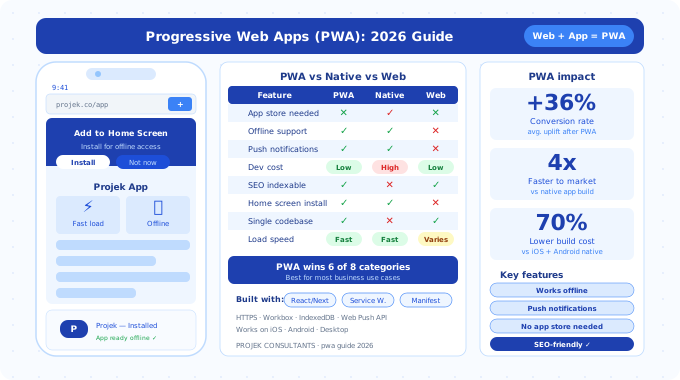
A PWA is a website built with modern web technologies that behaves like a native app. Users can install it directly from their browser to their home screen — no App Store or Google Play required. Once installed, it works offline, sends push notifications, loads instantly, and feels indistinguishable from a native application for the vast majority of use cases.
The Business Case Is Compelling
Building separate native apps for iOS and Android typically costs two to three times more than building a single PWA — and takes significantly longer to launch. A PWA shares one codebase across all platforms, is indexable by search engines (unlike native apps), and can be updated instantly without waiting for app store review processes that can take days.
When PWA Wins Over Native
PWAs are ideal for e-commerce stores, SaaS dashboards, content platforms, booking systems, and customer portals — essentially any application where users primarily need fast access to information and actions. Native apps retain their advantage for use cases requiring deep hardware integration, such as augmented reality, real-time video processing, or complex device sensor access.
The Tech Stack Is Mature
Built on Service Workers, Web App Manifests, and HTTPS, PWAs are now fully supported across iOS and Android. Frameworks like Next.js make PWA development straightforward for React teams, and tools like Workbox handle the complexity of offline caching strategies.
At Projek Consultants, we build PWAs for businesses across Singapore, Dubai, and Mumbai that deliver native-quality experiences at a fraction of the cost and timeline.
Want to explore PWA for your business? Talk to our team →