
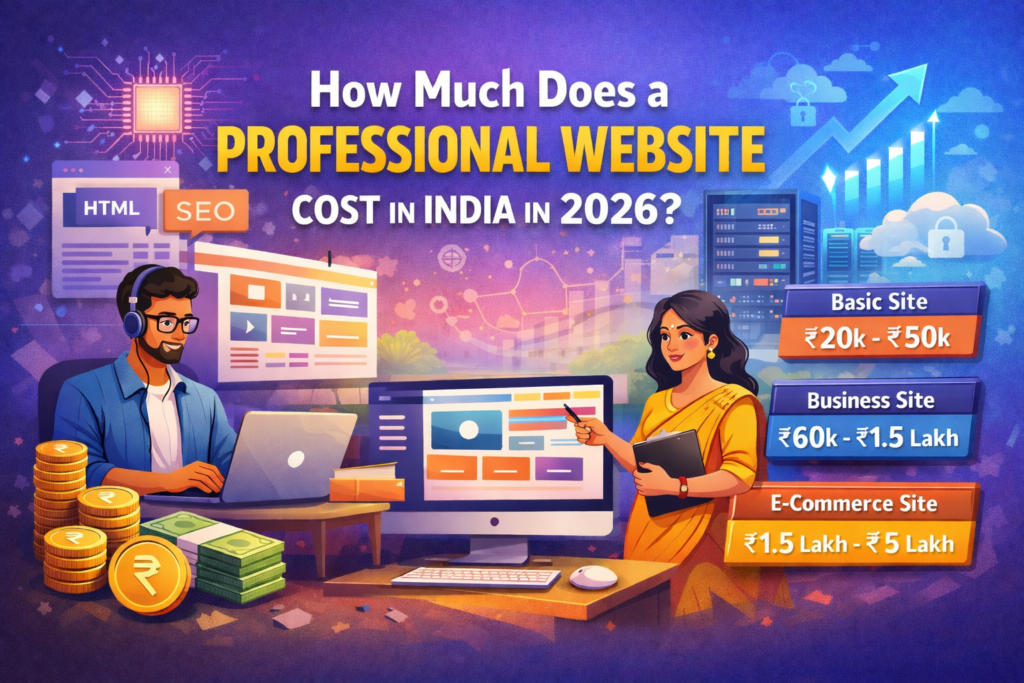
“How much does a website cost?” is the first question every business owner asks — and it almost always gets a vague answer. This guide changes that. Here’s exactly what you should expect to pay in India in 2026, and why.
You’ve decided your business needs a proper website. Maybe you’ve been running on a basic template for years, maybe you’re starting fresh, or maybe a competitor just launched something that made yours look dated. Whatever the reason, you need answers — real numbers, not “it depends.”
The Indian web development market in 2026 is diverse, competitive, and — if you know what to look for — exceptional value. From solo freelancers charging ₹8,000 for a WordPress site to full-service digital agencies delivering bespoke platforms at ₹8 lakh and above, the range is vast. What separates good investments from costly mistakes is understanding what drives the price and knowing which tier matches your actual business goals.
At Projek Consultants, we’ve built over 25 websites across industries ranging from healthcare and e-commerce to EV startups and NGOs — across India, Singapore, and the UK. This guide reflects real 2026 market rates, not theoretical benchmarks.
The Quick Answer: Website Cost in India by Type
Before diving into the details, here’s the full pricing landscape at a glance. These are current market rates for professionally built websites in India, delivered by reputable agencies or senior developers.
| Website Type | Starting Price | Typical Range | Timeline | Best For |
| Single Landing Page | ₹15,000 | ₹15K – ₹50K | 2–3 days | Campaigns, lead generation |
| Small Business Website (5–8 pages) | ₹35,000 | ₹35K – ₹1.2L | 2 weeks | SMEs, local businesses |
| Corporate / Brand Website ★ Popular | ₹80,000 | ₹80K – ₹3L | 4–6 weeks | Mid-size businesses, professional services |
| E-commerce Store | ₹1,20,000 | ₹1.2L – ₹6L | 4 weeks | Product businesses, D2C brands |
| Healthcare / HealthTech Website | ₹1,50,000 | ₹1.5L – ₹5L | 6 weeks | Clinics, hospitals, MedTech startups |
| E-learning / LMS Platform | ₹2,00,000 | ₹2L – ₹8L | 8–16 weeks | EdTech companies, training providers |
| NGO / Non-profit Website | ₹45,000 | ₹45K – ₹1.8L | 2-3 weeks | NGOs, foundations, social organisations |
| Custom Web Application | ₹3,00,000 | ₹3L – ₹20L+ | 12–24 weeks | SaaS products, portals, enterprise platforms |
Projek Insight: The ‘corporate website’ bracket (₹80K–₹3L) is where most growing businesses should invest. At this level you get custom design, proper SEO foundation, mobile optimisation, and a CMS you can manage — without paying enterprise rates.
6 Factors That Determine Your Website’s Final Cost
Two businesses can ask for ‘a 10-page website’ and receive quotes that differ by ₹2 lakh. Here’s exactly why — and how each factor affects your budget.
01 — Design Complexity
A bespoke, brand-aligned custom design costs 3–5× more than adapting a template. Custom UI/UX work means dedicated design hours — typically 30–80 hours for a mid-size site.
02 — Number of Pages & Content
A 5-page site is straightforward. A 30-page site with multilingual content, downloadable resources, and blog architecture is a project of a completely different order.
03 — Functionality & Integrations
Payment gateways, CRMs, booking systems, LMS platforms, membership portals — every integration adds development time and third-party licensing costs.
04 — SEO & Performance Setup
A properly SEO-architected site — schema markup, Core Web Vitals optimisation, structured sitemaps, on-page metadata — adds ₹15,000–₹40,000 to a typical project but pays back many times over.
05 — Who Builds It
A junior freelancer, a senior developer, a boutique agency, and an enterprise firm will all quote differently for identical scope. You’re not just paying for code — you’re paying for process, strategy, and accountability.
06 — Post-Launch Support
Hosting, security updates, CMS training, and ongoing maintenance typically add ₹5,000–₹20,000 per month. Build this into your budget from day one, not as an afterthought.
Freelancer vs Boutique Agency vs Enterprise Firm
One of the most consequential decisions you’ll make isn’t about the website itself — it’s about who you trust to build it. Each tier offers different tradeoffs.
| Freelancer | Boutique Agency ★ Best Value | Enterprise Firm |
| ₹8,000 – ₹60,000 | ₹60,000 – ₹5,00,000 | ₹5,00,000 – ₹25L+ |
| Low cost Fast for small scopes Direct communication ⚠ Risk: Single point of failure, inconsistent quality | Full team (design + dev + SEO) Strategic thinking included Structured delivery process Portfolio accountability ✓ Best value for growing businesses | Full digital strategy Custom development SLA-backed delivery Suited for large corporates and complex platforms |
For most Indian SMEs, startups, healthcare providers, and NGOs, the boutique agency tier represents the optimal investment. You get dedicated expertise, professional process, and genuine accountability — without the overhead of enterprise firm billing.
Hidden Costs Nobody Tells You About
The quoted project price is rarely the true total cost of ownership. Here are the additional expenses you need to factor into your budget:
- Domain name: ₹800–₹3,000/year depending on extension (.com, .in, .co.in). A premium domain can cost significantly more.
- Hosting: ₹4,000–₹25,000/year. Shared hosting is cheap but slow; managed cloud hosting (recommended) starts at ₹8,000/year.
- SSL Certificate: Often included by reputable agencies, but budget ₹1,500–₹6,000/year if not.
- Content creation: Copywriting, photography, and video production are almost never included in web development quotes. Professional copywriting for a 10-page site: ₹20,000–₹60,000.
- Premium plugins & licences: Page builders, SEO tools, booking plugins, payment gateways — budget ₹10,000–₹40,000/year for a feature-rich site.
- Ongoing maintenance: Security patches, CMS updates, performance monitoring — ₹5,000–₹15,000/month for a professionally managed site.
- SEO & digital marketing: A website without traffic strategy is a brochure no one reads. Monthly SEO retainers in India start at ₹15,000–₹40,000/month.
Watch Out: Quotes that seem suspiciously low often exclude content, hosting, SSL, and post-launch support entirely. Always ask for a total cost of ownership breakdown — not just the development fee — before signing any agreement.
Website Costs by Industry: What Projek Has Built
Generic pricing tables only tell part of the story. Here’s how real-world website costs play out across specific verticals, based on projects we’ve delivered:
Healthcare & Medical Tourism
Healthcare websites require an additional layer of trust architecture — clear credentials, HIPAA-aware data forms, patient testimonials, and seamless appointment booking. Our work with Synovia Health (US-based medical tourism) and EZE Medical Billing fell in the ₹1.5L–₹3.5L range, including compliance-ready forms, multilingual support, and integration with booking platforms.
E-commerce & D2C Brands
E-commerce costs scale rapidly with product count, payment gateway complexity, and inventory management needs. A clean WooCommerce or Shopify store for 50–200 products typically runs ₹1.2L–₹2.5L. Our work with Shubhdoggolife (pet lifestyle brand) and Blueast (eco-products) delivered full e-commerce capability with streamlined checkout, mobile-first design, and product filtering — within this range.
EdTech & Training Platforms
E-learning websites are among the most feature-heavy to build correctly. Video hosting, course management, student dashboards, payment gating, and progress tracking all add complexity. Budget ₹2L–₹6L for a professionally built LMS. Our work with Scalar Upskill and Divine Tech Skills demonstrates what a well-scoped EdTech build looks like within budget.
NGOs & International Organisations
Non-profits need websites that inspire trust, communicate impact clearly, and facilitate donations efficiently. The ₹45,000–₹1.8L range covers most NGO requirements well. Projects we’ve completed include Asia LEDS Partnership and Capacities India — both delivered within this bracket with custom branding and donation-ready architecture.
Corporate & Professional Services
For professional services firms — consulting, legal, finance, IT — a polished corporate website signals credibility before any conversation starts. The ₹80,000–₹2.5L range delivers custom design, case study architecture, team profiles, and lead capture. Our work with Logicore IT and Primo EMC falls in this bracket.
7 Questions to Ask Any Web Agency Before You Pay
A professional agency should be able to answer all of these confidently and specifically — not vaguely.
- “Can you show me websites you’ve built in my industry?” — Portfolio alignment to your vertical matters more than total number of projects.
- “Who specifically will work on my project?” — Some agencies pitch senior talent, then hand work to junior staff. Know your actual team.
- “What is your process for revisions and feedback?” — Unlimited revisions is a red flag — it suggests no defined scope. Clear rounds of feedback = professional process.
- “Does this quote include SEO setup?” — At minimum, expect: meta tags, image alt text, XML sitemap, schema markup, and Google Search Console setup.
- “What CMS will I use, and can I edit it myself?” — Your team should be able to update basic content without contacting the agency every time.
- “Who owns the website and all its assets after launch?” — You should own everything: domain, hosting account, code, design files, and content. No exceptions.
- “What does post-launch support look like?” — Get a clear answer about what happens when something breaks at 11 PM on a Friday.
Is a Professional Website Worth the Investment?
Let’s be direct: a well-built, SEO-optimised website is one of the highest-ROI marketing assets a business can have. Here’s a straightforward way to think about the numbers.
If your business closes clients at an average of ₹50,000 per project, and your website generates just 3 additional inbound leads per month — with even a 30% conversion rate — that’s ₹45,000 in additional monthly revenue, or ₹5.4 lakh per year. A ₹1.5 lakh website investment pays for itself in approximately 10 weeks.
The businesses that treat website development as a cost tend to buy cheap, rebuild within 18 months, and spend more in total. Those that treat it as infrastructure — like your office lease or your team’s salaries — build something that compounds in value over years.
The Right Framing: Don’t ask ‘how little can I spend on a website?’ Ask ‘what is a client worth to my business, and how many clients could a great website bring me?’ That calculation usually justifies a significantly higher investment than business owners initially expect.
FREE CONSULTATION
Ready to Build a Website That Actually Works for Your Business?
We’ve built 25+ professional websites across healthcare, e-commerce, EdTech, NGOs, and more — in India, Singapore, and the UK. Tell us about your project and we’ll give you an honest scope and quote within 48 hours.
Get a Free Quote → projekconsultants.com/contact
No obligation · No spam · Response within 48 hours